ChatService
ChatService handles the tool-call loop. It owns the chat instance and tool registry. Tools are registered via service.tools().add(...):
const config = new ChatServiceConfiguration();
config.maxToolCallRounds = 25;
config.systemPromptDir = "./prompts";
config.userPromptPaths = ["./context.md"];

const service = new OpenAIChatService(api, openAIConfig, config);
const chat = service.chat();
// ... setup messages ...
await service.send();
The base class accumulates stream events, assembles tool calls, recurses on tool responses, and errors safely.
Configuration
| Property | Env var | Default | Description |
|---|---|---|---|
maxToolCallRounds |
LLM_CHAT_MAX_TOOL_CALL_ROUNDS |
10 |
Max tool-call recursion depth |
systemPromptDir |
LLM_CHAT_SYSTEM_PROMPT_DIR |
./prompts/ |
Directory of .md/.txt system prompt files (read if it exists; never created) |
userPromptPaths |
LLM_CHAT_USER_PROMPTS |
"" |
Comma-separated file paths for initial user messages |
hooksDir |
LLM_CHAT_HOOKS_DIR |
unset | Directory containing .json hook definition files |
systemPrompt |
— | unset | Flat string that overrides the system prompt tree entirely; file-based system prompts are skipped |
trimMessages |
— | false |
Trim leading/trailing whitespace from assistant and reasoning content before storing |
contextWindowSizeHint |
LLM_CHAT_CONTEXT_WINDOW_SIZE_HINT |
0 |
Context window hint in tokens (0 = unlimited). Used by isContextWindowExceeded(): the service does not enforce it automatically |
Eager initialisation
By default, prompt files from systemPromptDir are loaded lazily on the first
send(). Call init() to load them upfront, allowing inspection or display of
the full system prompt (e.g. a /system command). When a flat
systemPrompt is set, the system prompt files are skipped; user prompt files
and JSON hooks still load.
await service.init();
const system = service.chat().getSystem();
// system.content now includes all file-based prompts under general
init() is idempotent; subsequent calls are no-ops until the next
service.clear() call.
To reload prompt files only (e.g. after modifying files on disk
at runtime), call loadPromptFiles() directly. Unlike init(), it always
re-reads the directory and replaces the general container contents.
Full reset
service.clear() resets the entire service to a clean state:
- Calls
JsonHookRegistry.clear(): disposes all JSON-loaded hooks - Calls
ChunkStream.clear(): removes chunks, resets sequence, unregisters chunk listeners - Calls
Chat.clear(): removes messages, clears system prompt, unregisters message listeners - Calls
ToolSuite.clear(): removes tools and packages, unregisters tool event listeners - Calls
resetTutorials(): re-attaches the tutorial container to the fresh system prompt tree - Resets the internal
_contextLoadedflag so the nextsend()re-runsinit()(re-loads prompt files and JSON hooks)
Tutorial reset
When chat.clear() is called directly (not through service.clear()), tool
tutorials in the system prompt tree are cleared along with everything else. To
re-attach and re-populate them from the still-registered tool packages, call
resetTutorials():
Message queue
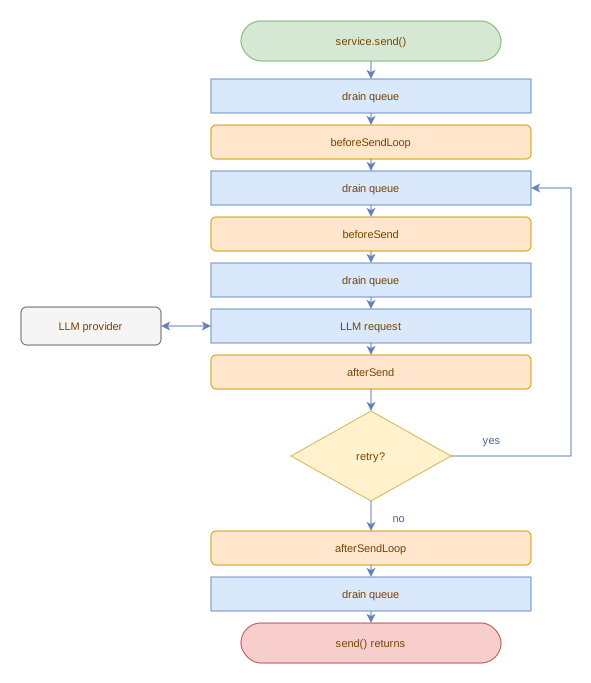
service.queue() returns a MessageWriter that stages messages for the next send() call without blocking the send mutex. This is useful for enqueueing messages from a concurrent context (timer, interrupt handler, etc.) without waiting for an in-flight request to finish.
await service.queue().user('Timer "build" (30s) has expired.');
await service.send(); // drains the queue into chat before sending
Messages enqueued via service.queue() are assigned an origin based on their role (User for user messages, Tool for tool messages, etc.).
Hooks enqueue messages through a separate HookMessageWriter interface. Hook-inserted messages are tagged with origin: Hook so they can be distinguished from user-provided or model-generated messages. See JSON hooks for details.
The queue uses its own mutex, so enqueuing is fast and independent of the send and chat mutexes.
For guidance on choosing between direct chat and the queue, see Building messages: Direct chat vs message queue.
Tool-call loop
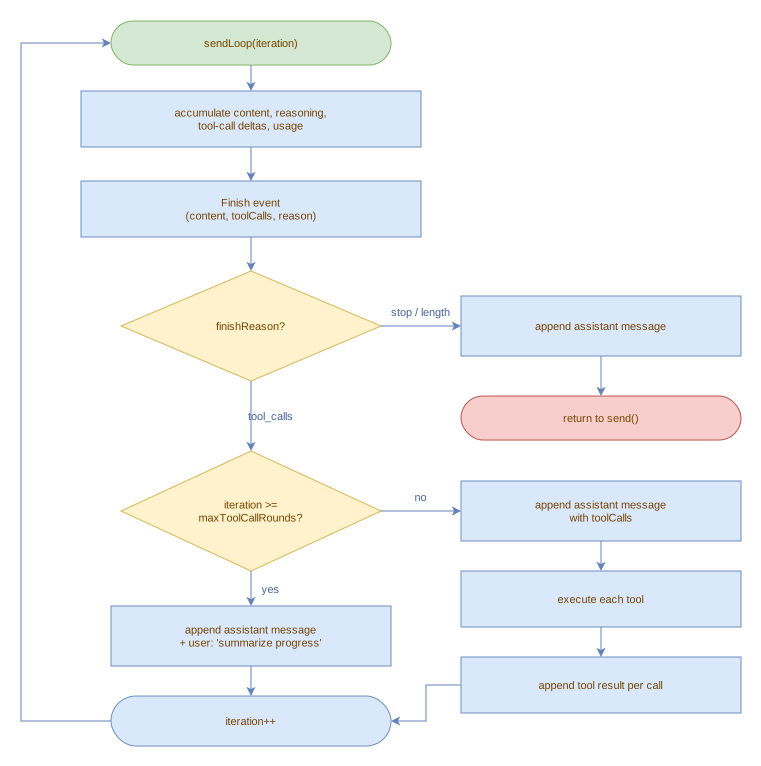
Each provider round is streamed by sendLoop(iteration), with iteration starting at 0. When the model returns tool calls, every tool runs and its results are appended as tool messages before the next round, which is a recursive sendLoop(iteration + 1) call. Rounds continue until the model stops calling tools, or until maxToolCallRounds is reached and the model is asked to summarise its progress.
Tool injection
service.injectToolCall(toolName, args) executes a registered tool and queues the result as if the model had called it, without firing tool hooks or waiting for an LLM round-trip.
await service.injectToolCall("fetch_weather", { city: "Berlin" });
service.setNeedsResend(); // flush in next send() iteration
The tool runs silently (no tool events are emitted), then an assistant message with a synthetic tool call and one or more tool result messages are enqueued into the message queue. injectToolCall does not call interrupt() or send(); the caller decides when to flush.
Throws if no tool named toolName is registered.
Context window estimation
The service provides two methods to estimate whether the conversation is
approaching the model's context window limit. This is useful for proactive
tokens management (trimming history, summarizing, or warning the user)
before calling send().
const tokens = await service.estimateTokens();
const exceeded = await service.isContextWindowExceeded();
What is counted
estimateTokens() estimates the total tokens for the full context that would
be sent to the LLM on the next send():
- System prompt: the effective system message: the flat
systemPromptwhen set, otherwise the composed prompt tree - Chat messages: all conversation messages (
chat.messages()) - Queued messages: messages staged via
service.queue()that have not yet been drained - Tool definitions: all registered tools serialized to their wire format
Strategy pattern
Both methods accept an optional TokenEstimator strategy to customize how
text is converted to token estimates:
The default implementation is CharCountEstimator (chars / 4), which
provides a rough approximation suitable for many models. Pass a custom
estimator for model-specific tokenization:
import { CharCountEstimator } from '@johannes.latzel/llm-chat';

// use a different chars-per-token ratio
const est = new CharCountEstimator(3);
await service.estimateTokens(est);
await service.isContextWindowExceeded(est);

// or implement the interface for a proper tokenizer
class TiktokenEstimator implements TokenEstimator {
    estimate(text: string): number {
        return encoding.encode(text).length;
    }
}
await service.estimateTokens(new TiktokenEstimator());
Threshold
Configure contextWindowSizeHint on ChatServiceConfiguration (default 0 =
unlimited). isContextWindowExceeded() returns false when the limit is
0. When set to a positive number, it returns true if estimateTokens()
exceeds the configured value.
const config = new ChatServiceConfiguration();
config.contextWindowSizeHint = 128_000; // 128k tokens
const service = new OpenAIChatService(api, openAIConfig, config);

// later, before send():
if (await service.isContextWindowExceeded()) {
    // trim or summarize
}
Context window handoff
When the estimated token count exceeds the context window, use chat.handoff()
to compact the conversation history. The method uses a strategy pattern: provide
a HandoffStrategy that returns a compacted message list to replace the current
history.
The strategy receives the current chat and must return an array of non-system messages. Typical strategies include summarising old messages into a single synthetic user message or dropping the oldest messages.
// Drop oldest messages, keeping only the last 5
const strategy: HandoffStrategy = {
    apply(chat) {
        const msgs = chat.messages();
        return msgs.slice(-5).map(m => ({
            ...m,
            content: `[compacted] ${m.content}`
        }));
    }
};

await chat.handoff(strategy);
How handoff works
- The strategy is applied to produce a compacted message list
- Current messages are appended to
chat.historicMessages()(read-only snapshot) - The chat is silenced, all messages are cleared, compacted messages are inserted
- Emission is re-enabled; hooks do not fire during the swap
Historic messages
Archived messages accumulate on chat.historicMessages():
Example: summarising handoff
import { ChatRole } from '@johannes.latzel/llm-chat';

// After detecting isContextWindowExceeded():
await chat.handoff({
    apply(chat) {
        const msgs = chat.messages();
        return [{
            role: ChatRole.User,
            content: `[Previous conversation summarised: ${msgs.length} messages archived]`,
            createdAt: new Date(),
            origin: 'system' as any
        }];
    }
});
Streaming
Stream hooks are documented in Stream hooks.
Service hooks
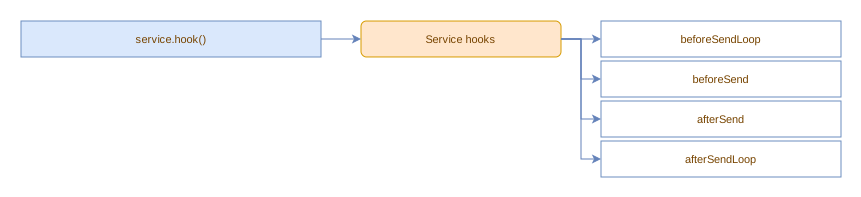
Service hooks fire around the LLM request lifecycle. They allow injecting messages or controlling retry behavior from inside the send loop.
Hook reference
| Hook | Callback | When it fires | Use case |
|---|---|---|---|---|
| .beforeSendLoop() | () => void | Before the do/while retry loop, after initial queue drain | Inject messages before any iteration |
| .beforeSend() | () => void | Each retry iteration, before _send(), after queue drain | Inject messages into the current LLM request |
| .afterSend() | () => void | Each retry iteration, after _send() | Check conditions and call service.setNeedsResend() to retry |
| .afterSendLoop() | () => void | After the do/while loop exits, before final queue drain | Inject messages after the loop finishes |
Queue drain sequence
The service drains the message queue at four points during send():
- Before
beforeSendLoop: picks up externally queued messages - At the start of each iteration, before
beforeSend: picks up messages queued during the previous iteration - After
beforeSend: picks up messages injected by the hook for the current iteration (they go into the immediately following_send()) - After
afterSendLoop: cleanup beforesend()returns
Reentrant safety
Calling service.send() from inside a service hook never deadlocks; the call
is detected as reentrant and the outer loop runs another iteration instead.
Limitation: reentrant send() from afterSendLoop is safe (no deadlock),
but the extra iteration is lost because the outer loop has already exited.
Use afterSend to trigger a retry from a hook.
Async support
Service hooks support async callbacks. Even though the callback type is () => void,
TypeScript accepts async functions (a function returning Promise<void> is assignable
to () => void). Async callbacks are awaited before the send loop continues,
ensuring messages queued via service.injectToolCall() or service.queue() are in
the queue before _drainQueue() runs.
service.hook()
    .beforeSend()
    .do(async () => {
        await service.injectToolCall("fetch_weather", { city: "Berlin" });
    });
The same applies to beforeSendLoop, afterSend, and afterSendLoop.